The Four Layers of Kabaddi: A Key to Reading Rules, Tactics and League Economics
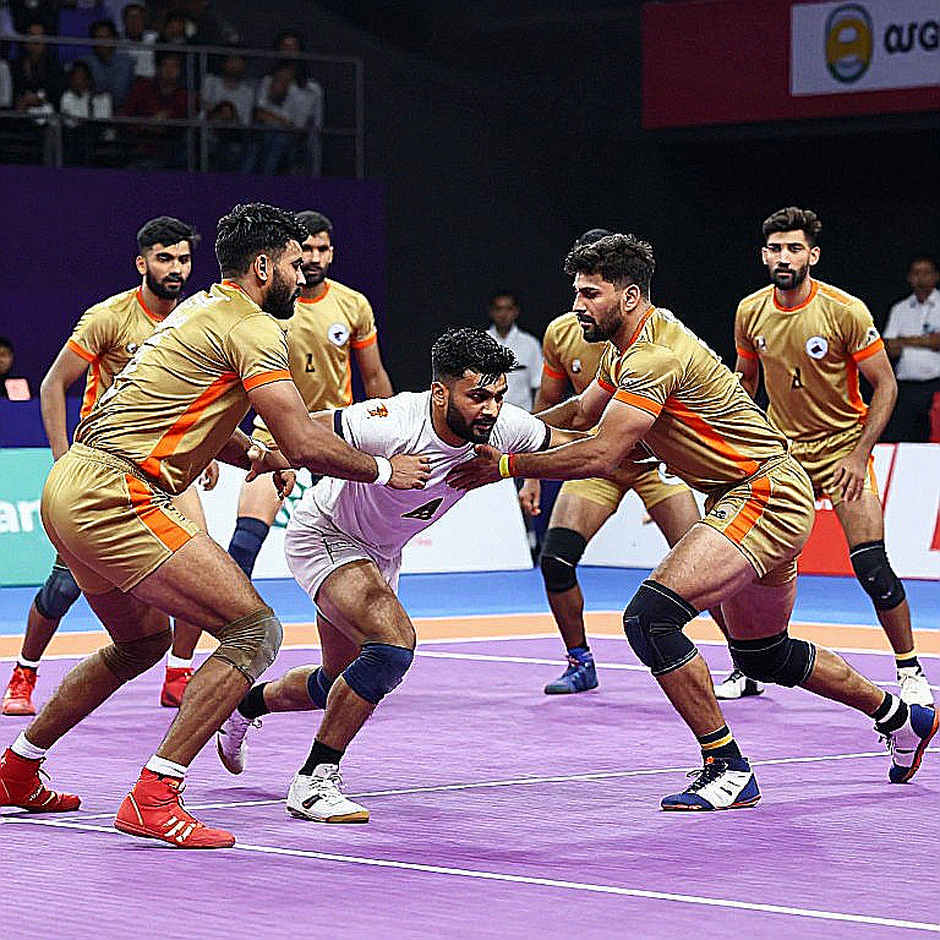
कबड्डी एक संपर्क-आधारित टीम खेल है जिसमें 7 खिलाड़ी मैट पर होते हैं। रेडर 30 सेकंड के भीतर विरोधी आधे हिस्से में जाकर किसी डिफेंडर को छूकर लौटता है और लगातार 'कबड्डी' का उच्चारण (कैंट) करना होता है। सफल रेड पर 1 पॉइंट, सफल टैकल पर 1 पॉइंट, बोनस लाइन छूने पर 1 अतिरिक्त पॉइंट (जब विरोधी के 6 या अधिक खिलाड़ी मैट पर हों), और पूरी विरोधी टीम के आउट होने (ऑल आउट) पर 2 पॉइंट मिलते हैं। लगातार दो खाली रेड के बाद तीसरी रेड 'डू-ऑर-डाई' होती है। भारत में पेशेवर कबड्डी का मुख्य मंच प्रो कबड्डी लीग है, जिसकी शुरुआत 2014 में हुई; यह फ्रेंचाइज़ी-आधारित है और टीमें नीलामी से बनती हैं। कबड्डी एशियाई खेलों का हिस्सा है (1990 से), लेकिन ओलंपिक कार्यक्रम में शामिल नहीं है। भारत में महिलाओं के लिए कोई घरेलू पेशेवर कबड्डी लीग नहीं है।
The most systematic way to understand kabaddi is to read it in four layers: rules, players and tactics, competition structure and competitive balance, and finally money, broadcast and governance. Most Indian sports coverage stops at the first layer — who scored, who won, who lost. A reader who wants to follow kabaddi with the seriousness reserved for cricket must learn to connect all four layers, because in this sport statistics, tactics and money are not separate things.\n\nThis backgrounder is not an evaluation of any single match or player. Its purpose is to lay out the framework through which any kabaddi report can be read — and to specify which claims should not be accepted without verification.\n\nLayer one: the rules stay fixed, their consequences do not\n\nThe core structure is simple. A raider enters the opponent's half within a 30-second limit, touches a defender and returns safely — that is a successful raid. Throughout the raid he must chant 'kabaddi-kabaddi' continuously; this is the cant. Break the cant and the raid is void. The defending side's job is to stop the raider inside its own half — that is a tackle, and it earns a point.\n\nThree rules sit on top of this and change the entire arithmetic. First, the bonus line: touching this line deep in the opponent's half earns an extra point, but only if the defending side has six or more players on the mat. Second, all out: when an entire side is ruled out, the opponent gets two bonus points and the eliminated side's players all revive and return — a full reset after a full wipe-out. Third, the do-or-die raid: after two consecutive empty raids the third raid must score, or the raider is out.\n\nThe strategic meaning is that kabaddi requires managing both time and risk. A raid consumes clock whether or not it produces points. Do-or-die pressure pushes teams towards conservatism; the fear of an all out pushes them towards aggression. When a commentator says a team 'lost momentum', what is actually happening is this tension between the three rules.\n\nOne nuance matters. Kabaddi is played in two distinct styles — Standard Style, used in the professional league and the Asian Games, and Circle Style, popular on Punjab's rural circuit. The scoring structures and mat dimensions differ. Any report should make clear which style it addresses; weighing the two on the same scale is a serious analytical error.\n\nLayer two: a raider's total points tell half the truth\n\nThe commonest error in kabaddi journalism is judging a player's strength by total raid points. Total points measure volume — how much was done. They do not measure how efficiently. The real benchmark is successful raid percentage: how many raids returned with a point. A raider scoring 300 points from 300 raids is efficient; a raider scoring 320 from 500 raids has heavy volume but low efficiency, and is a burden on his team, because every failed raid is an empty raid pushing the side towards do-or-die.\n\nAlongside, three other metrics complete the picture: raid points per raid, the ratio of touch points to bonus points, and average time consumed per raid. A raider who takes 25 seconds per raid but returns two points is as useful as one who scores in eight seconds — but their roles differ. The first absorbs do-or-die pressure; the second changes the tempo of the game.\n\nThe biggest structural risk in squad construction is single-point dependence on a star raider. When one raider accounts for more than thirty per cent of raid points, the opponent's entire tackle plan converges on him. His injury, loss of form, or simply one excellent defensive pairing can collapse the team's scoring. Successful franchises always carry a second and third raiding option, even at lower volume.\n\nDefence: beyond the tackle success rate\n\nDefence cannot be measured by tackle count alone. The gap between tackle attempts and tackle successes is decisive. A defender with 45 successes from 100 attempts is better than one with 30 from 60 — yet both show similar tackle points. It also matters where the tackle happened: a solo tackle (high risk) or a chain tackle (collective, safer). A super tackle — executed when three or fewer defenders remain — yields two points and can turn a match; defenders capable of tackling in such numbers carry a premium.\n\nModern defence is not only about stopping the raider but about forcing him into a particular direction. The corner defender's job is to pull the raider towards the boundary and limit his momentum; the cover defender's job is to shut the corridor on the other side. When that pairing works, the raider runs out of space and retreats in haste — and that empty raid is worth almost as much as a tackle point, because it pushes the opposition towards do-or-die.\n\nLayer three: competitive balance in the league\n\nIndia's professional kabaddi structure rests on a single major platform — the Pro Kabaddi League, launched in 2026 and operated by Mashal Sports. It is franchise-based, squads are built through an auction, and season broadcast is concentrated with one major sports network. The strength of this structure is that the auction forces competitive balance every season, since no team can retain every elite player indefinitely. The weakness is that the entire professional apparatus depends on one league, one broadcaster and one sponsorship market.\n\nThree practical measures assess competitive balance. First, how many teams remain genuinely in playoff contention — if fewer than half are mathematically alive in the final third of the season, the league is unbalanced. Second, whether the winning pattern is raid-heavy or defence-heavy, which shows where auction money is going. Third, whether home advantage is measurable; if home teams' win percentage is clearly elevated, travel, mat familiarity and crowd pressure are all operating.\n\nLayer four: the logic of auction money\n\nThe auction is the most read and least understood kabaddi story. A high price for a player is neither an achievement nor a mistake in itself — it becomes meaningful only when weighed against two or three seasons of actual output. A simple test: divide the price by the player's expected raid or tackle points and see how far the cost per point exceeds the team average. A large gap indicates premium risk — the market has bought the player's past more expensively than his future.\n\nThree revenue streams are decisive: broadcast rights, sponsorship and ticketing. Broadcast rights are the largest and most concentrated, making dependence on a single buyer the biggest structural risk. Sponsorship is usually split between league and teams and therefore offers some diversification. Ticketing remains a small stream in India, but it is the indicator of whether audiences are moving from screens to stadiums — the most credible proof of long-term popularity.\n\nThe regional pipeline: from the akhada to the mat\n\nKabaddi's greatest strength is its folk roots. Village mud akhadas across Haryana, Punjab, Uttar Pradesh, Maharashtra and Tamil Nadu are the sport's real talent farm. The game there is not a season's calendar but a daily habit; that is why training costs are far lower than in cricket and the talent search is far wider. Government sports quotas in railways, police and the armed forces provide a genuine economic safety net — the least discussed and most functional part of kabaddi's recruitment system.\n\nThe largest structural gap in this pipeline is the absence of a professional platform for women's kabaddi. The Indian women's team is internationally competitive and girls play from village to district level, yet there is no domestic professional league. The direct consequence is that a woman player has limited economic reason to make the sport a career — a warning for any long-term talent strategy. Any growth story about kabaddi that omits the question of a women's league is half a picture.\n\nThe tactical part that does not show on the scoreboard\n\nA coach's real work is creating and avoiding do-or-die situations. An experienced side knows when to play a deliberate empty raid to run down the clock and when to attack. Likewise, the use of substitutions and reviews — where limited opportunities are spent — can change a match. A team that uses its bench only for fatigue often breaks down physically late in the season; a team that rotates shares the load and arrives fresher in the playoffs.\n\nThere is a limit to all this: kabaddi is a contact sport, and tackle injuries, ankle and knee sprains and shoulder damage are the ordinary cost of the game. Any team assessment must therefore put player availability at the top. Season statistics are complete; availability changes daily — which is why kabaddi news ages quickly.\n\nThe international picture: beyond the league\n\nKabaddi's international structure runs on different logic from the domestic league. It has been part of the Asian Games since 2026, with India the dominant power. But Iran has broken that monopoly in recent years — winning men's kabaddi gold at an Asian Games edition, the most significant competitive shift in the sport's history. Bangladesh, South Korea and Chinese Taipei are also raising their level.\n\nThe real currency of international strength is the Olympics, and kabaddi is not on the programme. Any claim about it is an effort, not an achievement. When a report invokes the Olympics, three things should be checked: who made the claim, on what date, and whether an official document or international federation announcement accompanies it.\n\nRisk matrix: five real threats\n\nFirst, broadcaster dependence — the entire showcase model rests on one broadcast partnership. Second, single-player dependence — a star raider's injury or form decides a team's competitiveness. Third, the absence of a women's league, which keeps half the talent pool outside formal employment. Fourth, governance — administrative disputes between state and national federations, technical standardisation and anti-doping systems are permanent risks; age disputes and rule-interpretation controversies recur in South Asian kabaddi. Fifth, audience fatigue — with rival domestic leagues in badminton, wrestling and volleyball growing, competition for screen time is intensifying.\n\nThe most underrated of these is the fourth. Governance disputes do not immediately reduce popularity, but they create the risk of cancelled events, bans and questions over national-team eligibility — and one such event can wreck a season's entire economic calculation.\n\nConclusion: what to look for in the next report\n\nAny kabaddi story can be assessed with four questions. First, is the statistic about volume or efficiency? Second, what is the date — because within a season injuries, form and standings shift every few weeks, and a month-old story is history, not information. Third, who is the source — league official, broadcaster, agency wire, or a self-media page? Fourth, has the piece defined its claim — which metric, over what period, against whom? A report that answers these four gives information; one that does not gives only enthusiasm.\n\nKabaddi's biggest structural change is now happening off the mat: the value of the television library, the beginnings of data-driven analysis, fantasy and digital content markets, and the reshaping of player economics through the auction. Without understanding that layer, the next decade of kabaddi cannot be written.