
KabaddiCommonwealth Kabaddi Championship 2026: India Eye Big Win Over Nigeria, But the Three Wins Hide Larger Stories
Commonwealth Kabaddi Championship 2026: India Eye Big Win Over Nigeria, But the Three Wins Hide Larger Stories
कॉमनवेल्थ कबड्डी चैंपियनशिप 2026 के चौथे दिन भारत का सामना नाइजीरिया से है। भारत ने इंग्लैंड को 46-26, युगांडा को 44-30 और मलेशिया को 37-23 से हराया है, जबकि नाइजीरिया तंजानिया से 17-66 और इंग्लैंड से 18-68 हारा है। भारत स्पष्ट पसंदीदा है, लेकिन उसकी जीत के अंतर सामान्य हैं और डिफेंस ने प्रति मैच 23-30 अंक दिए हैं। इंग्लैंड ने नाइजीरिया के खिलाफ 68 अंक बनाए थे, पर भारत के खिलाफ सिर्फ 26, जो भारतीय डिफेंस का मजबूत संकेत है। कप्तान सुरजीत सिंह हैं, लेकिन खिलाड़ी-स्तरीय आंकड़े उपलब्ध नहीं हैं। ईरान की अनुपस्थिति से भारत का प्रभुत्व बढ़ा-चढ़ाकर दिख सकता है। यह इवेंट कॉमनवेल्थ गेम्स का हिस्सा नहीं है और मानक कबड्डी शैली में खेला जाने की संभावना अधिक है।
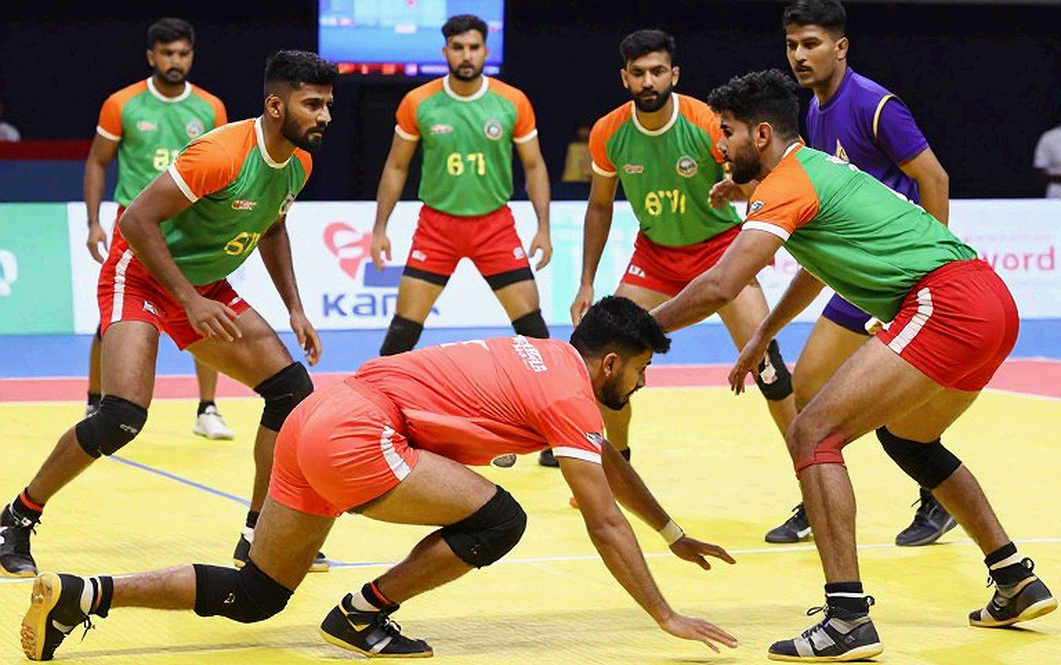
The Commonwealth Kabaddi Championship 2026 enters its fourth day with India set to face Nigeria. On form and scorelines, India are overwhelming favourites, but the match is about more than a likely win. India have beaten England 46-26, Uganda 44-30 and Malaysia 37-23. Nigeria, by contrast, have lost 17-66 to Tanzania and 18-68 to England. Those results reveal three things: India's depth, Nigeria's structural weakness, and a wide gap between tiers in the tournament. India's start has been described as explosive and they are seen as clear favourites, yet it has also been acknowledged that India are not winning by huge margins, leaving some fans disappointed. That contradiction is the central story.
A quick rules primer helps. A raider crosses into the opponent's half, touches a defender and returns within 30 seconds to score. Throughout the raid the raider must chant ‘Kabaddi… Kabaddi’ to prove he is not inhaling; if the chant breaks, the raid is void. Defenders score by tackling the raider in their own half. When an entire side is out, the opponent gets two bonus points and the whole team revives; this is the All Out. After two empty raids, the third becomes a do-or-die raid: failure means the raider himself is out. A tackle completed with three or fewer defenders is a Super Tackle, worth two points. These rules directly shape the scorelines. Totals of 46, 44, 37 and opponent totals of 68, 66 indicate fast tempo, frequent tackles and repeated All Outs. The source does not explicitly state the rule variant, but a multi-nation federation event with such high scores strongly suggests Standard Style, with a rectangular court and 7 v 7. Circle Style cannot be fully excluded, but it is unlikely.
India have scored 127 and conceded 79 across three games, an average of about 42 scored and 26 conceded. Wins by 20, 14 and 14 points are comfortable but not dominant. A truly dominant defensive side in a low-tier field would usually concede fewer than 20. India conceding between 23 and 30 is a yellow flag: their defence is good enough to win comfortably, but not airtight against elite raiders. There is also a strong positive signal. England scored 68 against Nigeria but only 26 against India, a 42-point suppression. That is the strongest evidence here that India's defence is operating at a high level. India's margins should therefore be judged in the context of opponent quality, not raw totals alone.
India's captain is Surjeet Singh, but the source does not state whether he is a raider, defender or all-rounder. No player-level statistics are available: no raid points, tackle points, success rates or roster details. It is therefore impossible to confirm or rule out dependence on a single star raider. That is a data gap, not a clean bill of health. Bench depth, rotation and all-rounder contribution also cannot be assessed. What is clear at team level is that India have a balanced, defence-controlled profile. Under Surjeet Singh they have won all three matches, but the lack of big margins has raised questions.
Nigeria define the tournament's tier structure. Their 17-66 and 18-68 losses represent margins of about 49 and 50 points. In kabaddi, such blowouts are not only talent-driven; the All Out rule amplifies them. Once a team is outclassed, the opponent forces repeated All Outs and the gap compounds. Nigeria belong in tier three. India are tier one; England, Tanzania, Malaysia and Uganda are tier two; Nigeria are tier three. African participation signals development and outreach, not competitive depth. The source lists only six teams; the possible absence of Pakistan and Bangladesh, both with kabaddi traditions, would thin the field further, though their absence is not explicitly confirmed.
The biggest structural fact is Iran's absence. Iran are not a Commonwealth member, so they are not in this field. But Iran are India's real rival at the top, having won men's gold at the 2026 Asian Games and proven India can be beaten. Without Iran, India's three wins are against tier-two and tier-three opposition and can flatter India's apparent dominance. This is a Commonwealth-branded standalone championship, not a Commonwealth Games event; kabaddi is not on the Commonwealth Games programme. Its prestige sits below the Asian Games, the Kabaddi World Cup and the Asian Kabaddi Championship. The Commonwealth label is a framing and marketing device that widens the geographic field, not a guarantee of top-tier quality.
The commercial and media picture matches this level. The available article is a live streaming and telecast guide, meaning distribution is streaming-led and relatively low-tier. This is not a Pro Kabaddi League franchise event, so auction, salary or franchise-premium analysis does not apply. No sponsorship, rights-value or player-contract data is provided, so no firm commercial risk judgment is possible. The signal is that standalone broadcast revenue is likely limited and the event functions more as content, outreach and soft-power vehicle. For India, it helps maintain visibility and extend kabaddi's reach to Anglophone and African nations.
Governance risk is mainly opacity. The source does not identify the organizer, whether the event has International Kabaddi Federation sanctioning, or the standard of refereeing and video review. Kabaddi has a history of parallel federations and disputed events, so these questions matter. The event does not advance kabaddi's Olympic case, because Olympic criteria require a larger number of participating countries, continental coverage and women's-game depth. Without strong teams such as Iran and Korea, it does little to close those gaps.
India versus Nigeria should therefore not be read only through the scoreboard. India are heavy favourites, but the analytical question is how big they win and whether their defence looks stricter against Nigeria. A win by more than 30 while conceding fewer than 20 would be a strong signal. If Nigeria again score around 20, it will expose both softness in India's defence and the tournament's weak depth. Overall, the championship shows kabaddi's internationalisation is broad but shallow: many flags, few competitive nations. India's real test will come against a side like Iran; until then, the three wins need to be read with context.
संबंधित खिलाड़ी
लोकप्रिय/पसंदीदा पुस्तकें
Zero Information in Kabaddi Analysis Pipeline Exposes a Critical Data-Quality Failure2026-11-06
No Revolution from Empty Data: The Real Story Behind Stage-1 Failures in Kabaddi Reporting2026-11-04
Haryana's 'Champions League' and PKL's Broadcast Crisis: The Real Story Behind the Rs 5 Crore Purse and 6,400 Trials2026-11-04
Kabaddi Champions League: Ten Teams, a Rs 5 Crore Purse — and the One Story Buried in Paragraph Four2026-11-04
Kabaddi Champions League Expands to 10 Teams With a Rs 5 Crore Auction Purse — But PKL's Broadcast Crisis Is the Real Story2026-11-03
1,863 Days and 13 Points: The India-Iran Kabaddi System Ledger, from Jakarta's 18-27 to Hangzhou's 33-292026-11-03
When the Kabaddi Analysis Pipeline Fails: The Anatomy of a Zero-Information Deconstruction2026-11-03
Kabaddi's Second Innings: From the Clay Court to the Broadcast Studio2026-11-02
अनुशंसित
Kabaddi Champions League Expansion: 10 Teams, Rs 5 Crore Auction Purse — and the Buried Story of Pro Kabaddi League's Broadcast Crisis2026-11-03
Commonwealth Kabaddi Championship 2026: Before India vs England, the Rotation Receipt Matters More Than the Scoreline2026-10-23
Commonwealth Kabaddi Championship 2026: Nine Days, Thirteen Teams, and the Schedule Nobody Is Reading2026-10-23
A Sport Balanced on a Single Breath: Kabaddi's Professional Journey, Asian Geography, and Its Unseen Economy2026-11-02
On Day 1 in Ahmedabad, Fourth Place Belongs to a Team That Has Not Played a Single Match2026-10-30
First Commonwealth Kabaddi Championship in Ahmedabad: 23 Teams, 62 Matches, and a Question the Scoreboard Won't Answer2026-11-04
Kabaddi: From the Mud Court to the Screen — The Full Story of a Sport2026-10-31
Reading India’s 3-0 Start: Iran’s Absence and the All Out Maths at the Commonwealth Kabaddi Championship 20262026-10-30
अनुशंसित
Commonwealth Kabaddi Championship 2026: India's Dominance Continues, Big Win Expected Against Nigeria2026-10-27
The Jakarta Receipt: Why Iran Belongs in the First Line of Every India Kabaddi Forecast2026-10-24
Kabaddi's Real Scoresheet Is the Body, Not the Points2026-10-31
Commonwealth Kabaddi Championship 2026: India vs England — The Real Score Will Be Written on the Baulk Line, Not the Board2026-10-24
Kabaddi Champions League Expands to 10 Teams With a Rs 5 Crore Auction Purse — But PKL's Broadcast Crisis Is the Real Story2026-11-03
Kabaddi Champions League: Ten Teams, a Rs 5 Crore Purse — and the One Story Buried in Paragraph Four2026-11-04
First Commonwealth Kabaddi Championship in Ahmedabad: A Brilliant Experiment for 2030 Commonwealth Games or Just Promotion?2026-11-05
From TransStadia's Empty Mat to Jakarta's Bronze: The Ledger of Kabaddi's Commercial Reporting2026-11-06